Get In Touch
Let's Create
Something
Ready to level up your drumming, book a live performance, or discuss a studio project? Drop a message.
LocationWorldwide

Ready to level up your drumming, book a live performance, or discuss a studio project? Drop a message.
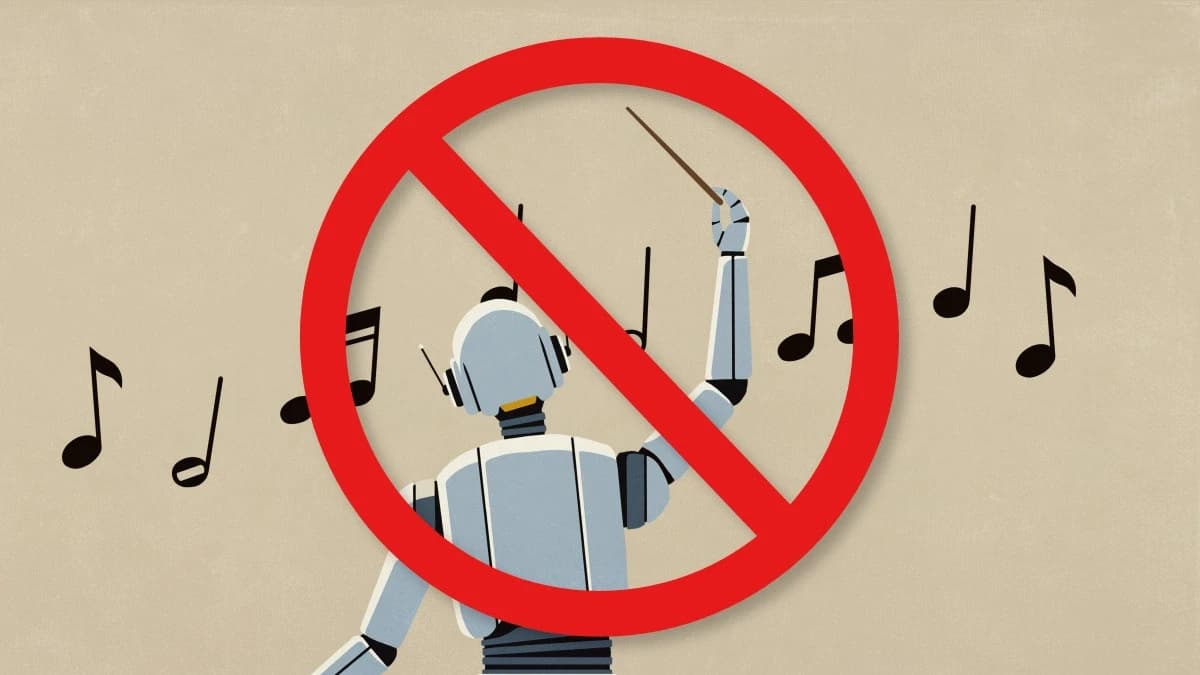
Artificial Intelligence has rapidly entered nearly every industry in the world, and music is no exception. Many people celebrate AI as a revolutionary tool that can generate songs, melodies, and even full productions within seconds. On the surface, it sounds exciting and convenient. But behind that convenience lies a serious problem that is slowly destroying the value of real musicianship and artistic expression.
Today, anyone can whistle a melody, record a simple beatbox rhythm, or type a few prompts into an AI generator and instantly receive a finished track. No years of practice. No understanding of music theory. No emotional investment. No artistic journey.
Sounds impressive, right?
But take a moment to think about what is happening behind the scenes.
Streaming platforms are now being flooded with millions of AI-generated tracks. These platforms have become digital garbage collectors filled with mass-produced, emotionless content generated in seconds. Meanwhile, real musicians — people who spend months or even years writing, practicing, recording, and refining their art — are being buried under an endless wave of robotic noise.
Talented artists release songs crafted with passion, emotion, and human experience, only to receive little to no attention because algorithms are overwhelmed by quantity instead of quality.
And this is where the real danger begins.
Many people who strongly support AI-generated music do not fully understand how real art is created. Creating something truly unique takes time, discipline, sacrifice, creativity, and emotional depth. Great music is not just sound — it is experience, personality, struggle, and soul translated into art.
Taking shortcuts may give instant results, but it also removes the learning process that shapes real artists.
Imagine visiting an international music exhibition where companies from around the world present instruments, amplifiers, recording equipment, and innovative technology.
You stop at a drum company’s booth and ask:
“Why would anyone spend years learning drums when AI can generate any beat instantly?"
That question alone reveals a complete misunderstanding of what music truly is.
Drumming is not simply about producing rhythm. It develops coordination, discipline, timing, creativity, groove, emotion, and human expression. Even basic limb independence exercises require intense practice and mental focus. A real drummer brings dynamics, feel, imperfections, energy, and personality into music — things that algorithms cannot genuinely replicate.
Most importantly, the drummer often defines the pulse, energy, and character of an entire composition.
AI can imitate patterns, but it cannot replace human experience.
Unfortunately, many people today are more interested in instant gratification than artistic growth. Clicking a button to generate a track and posting it online does not make someone a musician in the traditional sense. Real musicians dedicate years of their lives to mastering their craft.
This is not an argument against technology itself. AI can be a useful tool in certain areas of production and workflow. But when artificial generation begins replacing human creativity instead of supporting it, the industry loses its soul.
If you are a real musician, artist, producer, or listener who still values authentic human expression, support real art:
Music was never meant to be manufactured like disposable content. It was meant to connect human beings through emotion, imperfection, and truth.